Overview of Ringing in 2025
This article provides a summary of our activities in 2025.
During the year we continued to contribute important population data to the British Trust for Ornithology (BTO) Constant Effort Site (CES) and Recapture of Adults for Survival (RAS) schemes. Inputs to these projects were led by Heather Coats, Wayne Morris and Richard Dann.
Training was delivered throughout the year, particularly at Oxwich Marsh, where the largest numbers of birds were captured and sessions were held weekly (as weather permitted) and more regularly during migratory periods. This was led by Owain Gabb, with support from the other group trainers, A and C permit holders. This training included the Welsh Ringing Course, which was held in early September. Large numbers of birds, in terms of the Group total, were also caught by Richard Dann in his coastal garden at Southgate.
Project progress, species totals (including notable species and aged birds) and group news are summarised below.
Project Updates
Cwm Clydach Pied Flycatcher RAS Project
Our long-running RAS project at Cwm Clydach in the Swansea Valley was registered in 1998, although ringing of pied flycatchers has taken place at the site since 1986. During this time we have provided data that has helped researchers at Cardiff University understand and track the decline of the species in lowland South Wales.
The season started solidly with 20 nests to the egg stage (22 in 2024, 17 in 2023 and 16 in 2022). Encouragingly, 19 of these nests were successful with a total of 92 young fledged. By way of contrast, in 2024 only 18 of 22 nests hatched eggs and bad weather led to 10 dead broods and only 29 young fledged. Correspondingly in 2025 there was an upturn in adults captured (26), with 15 of these being recaptures and 11 newly-ringed (in 2024 the lack of productivity made it very challenging to capture adults and the number was limited to 10 recaptures and four new birds). Of the adults that were recaptured, three (two males and a female) came from the same brood, and had been ringed at Cwm Clydach as pulli in 2023. There were no significant age retraps with the oldest birds being from 2022.
RSPB Gwenffrwd-Dinas Pied Flycatcher RAS Project
Once more, several Gower Ringing Group members contributed to the pied flycatcher RAS at RSPB Gwenffrwd-Dinas run by the Fledgemore Nest Recording Group.
The RAS was registered in 2021 although monitoring pied flycatchers across the reserve has been undertaken for decades. The reserve is large with several sub-sites containing over 650 nest boxes and provides opportunities for group members to gain experience nest monitoring and ringing cavity-nesting species.
2025 was a much better breeding season that 2024. 122 pairs successfully produced a total of 713 fledglings. In addition, 229 adults were trapped of which 121 were retraps from previous seasons. This was the highest number of retraps since the Group took on the project. All retraps were site faithful to the reserve with the exception of an adult female originally ringed at nearby Llyn Brianne.
Dipper RAS Project
The dipper RAS covering water courses in Bridgend, Caerphilly, Neath-Port Talbot and Rhondda Cynon Taf continued. Over 50 locations were monitored in total.
After a poor breeding season in 2024, it was pleasing to note better site occupancy and breeding success in 2025. The 32 active nests produced 117 fledglings with a further 35 adults trapped. Of these, 23 were birds captured in previous seasons.
Southgate Jackdaw RAS project
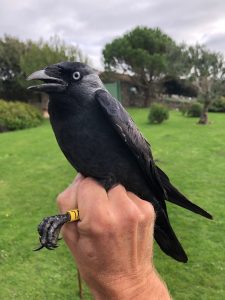
The RAS project on jackdaws at Southgate, near Pennard, Gower, entered its fourth year. A total of 192 new birds were ringed (200 in 2024), and 90 recaptured (49 in 2024), so it was a very successful year. The recaptures included two birds which had previously been metal-ringed only.
There were 239 field observations of colour-ringed birds over the year. These were primarily from the ringing site, but there was also some evidence of dispersal. The most distant of the sightings from the ringing site was at Manorbier, Pembrokeshire, approximately 50 km to the west north-west, with there were other sightings of birds from local villages and suburban areas that included Kittle, Newton and Bishopston.
Wildfowl and Wetlands Trust CES
This was the 24th year of the CES project at WWT Llanelli. Twelve visits were made between 29 April and 21 August, and a total of 365 birds of 20 species captured. Of these 258 were new birds and the remainder recaptures.
The commonest species caught were blackcap (37), chiffchaff (47) and dunnock (35). Of note for the site were a spring whitethroat on 14 May, dispersing juvenile treecreepers on 9 June and 10 July and a young garden warbler on 10 August. There were no willow tit captured on CES this year; in 2024 a female willow tit in breeding condition was captured but successful breeding was not confirmed as no juveniles were caught.
Garden CES, Crynant (Dulais Valley)
The CES started in 2020 during the lockdown. This year 12 visits were made between 28 April and 22 August inclusive. The total of 324 birds of 18 species captured represented a small increase on the past two years (in 2024 304 birds of 18 species and in 2023 280 birds of 16 species were captured). Siskin was again the most numerous species, with 106 captured (164 in 2024, 73 in 2023, 391 in 2022). Blue tit numbers rebounded to 64 (with 56 of these being juveniles indicating a good breeding season locally) from 34 in 2024, when few young birds caught. Redpoll, which has been a feature of the site in previous years, was not captured.
The oldest recaptures were a male blackbird which had been ringed as a juvenile in 2020 and a male goldfinch also ringed in 2020 as a juvenile. Notable species for the site included sparrowhawk, the third to be captured on site and the first female (an adult).
Species Totals and Notable Captures
It was an excellent year in terms of total numbers of birds captured, and an above par one in terms of the range of species processed. A total of 10,459 birds of 85 species were captured (as compared to 9,861 of 91 species in 2024, 7,276 birds of 73 species in 2023, 9,319 birds of 82 species in 2022 and 9,455 birds of 91 species in 2021). The increased number compared to previous years reflects the high level of effort, a productive year for tits and reed bed warblers, and the increased number of permit holders running their own sites. Poor mid-late autumn weather limited the potential to run group ringing sessions between mid-September and November.
Species totals for 2025 are provided in Table 1 below alongside a breakdown for 2024. The data excludes subsequent recaptures of birds ringed / initially recaptured in the respective years, so refers to ‘unique’ birds (reducing the total from 10,459 to 8,186). For the purpose of comparing annual totals Siberian chiffchaff has been treated as a species (but is a subspecies (tristis) of common chiffchaff).
Table 1. Unique Birds* Processed by Gower Ringing Group in 2025
| Species | Individuals (2025) | Individuals (2024) |
| Barn owl | 1 | 1 |
| Black-faced bunting | 0 | 1 |
| Barred warbler | 1 | 0 |
| Blackbird | 171 | 180 |
| Blackcap | 383 | 378 |
| Black-headed gull | 2 | 0 |
| Blue tit | 1207 | 677 |
| Brambling | 1 | 1 |
| Bullfinch | 69 | 71 |
| Buzzard | 6 | 2 |
| Carrion crow | 2 | 2 |
| Cetti’s warbler | 67 | 78 |
| Chaffinch | 175 | 229 |
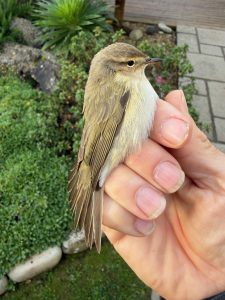
| Chiffchaff | 586 | 562 |
| Chiffchaff (Siberian – tristis) | 4 | 1 |
| Coal tit | 217 | 57 |
| Collared dove | 7 | 16 |
| Crossbill | 0 | 1 |
| Cuckoo | 1 | 0 |
| Curlew sandpiper | 0 | 1 |
| Dartford warbler | 1 | 0 |
| Dipper | 44 | 47 |
| Dunlin | 88 | 25 |
| Dunnock | 177 | 154 |
| Fieldfare | 1 | 2 |
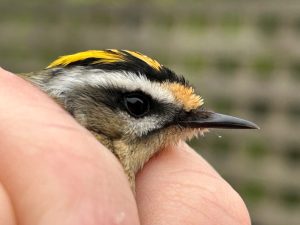
| Firecrest | 18 | 22 |
| Garden warbler | 15 | 11 |
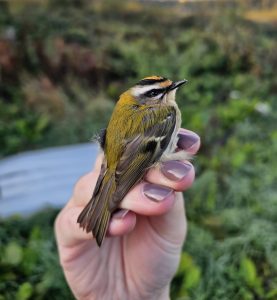
| Goldcrest | 154 | 102 |
| Goldfinch | 462 | 461 |
| Goshawk | 2 | 1 |
| Grasshopper warbler | 25 | 16 |
| Great black-backed gull | 1 | 2 |
| Great spotted woodpecker | 43 | 39 |
| Great tit | 327 | 230 |
| Green woodpecker | 4 | 2 |
| Greenfinch | 92 | 199 |
| Grey heron | 1 | 0 |
| Grey wagtail | 16 | 29 |
| Herring gull | 5 | 6 |
| House martin | 0 | 9 |
| House sparrow | 235 | 311 |
| Jack snipe | 5 | 9 |
| Jackdaw | 260 | 249 |
| Jay | 3 | 1 |
| Kestrel | 1 | 0 |
| Kingfisher | 4 | 8 |
| Lesser black-backed gull | 0 | 3 |
| Lesser whitethroat | 4 | 6 |
| Linnet | 34 | 60 |
| Little stint | 1 | 1 |
| Little tern | 1 | 0 |
| Long-tailed tit | 171 | 148 |
| Magpie | 33 | 42 |
| Mallard | 0 | 1 |
| Marsh tit | 3 | 6 |
| Meadow pipit | 73 | 68 |
| Mistle thrush | 0 | 2 |
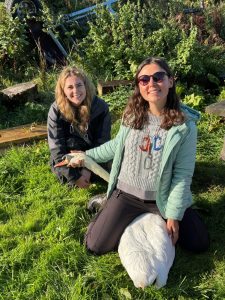
| Mute swan | 6 | 0 |
| Nightjar | 2 | 4 |
| Nuthatch | 16 | 12 |
| Peregrine falcon | 1 | 0 |
| Pied flycatcher | 165 | 285 |
| Pied / white wagtail | 17 | 14 |
| Redpoll | 14 | 7 |
| Redstart | 1 | 5 |
| Redwing | 69 | 140 |
| Reed bunting | 28 | 35 |
| Reed warbler | 475 | 319 |
| Ring ouzel | 0 | 1 |
| Ringed plover | 53 | 55 |
| Robin | 233 | 240 |
| Rock pipit | 5 | 3 |
| Rook | 23 | 2 |
| Sand martin | 6 | 3 |
| Sedge warbler | 309 | 326 |
| Siskin | 342 | 379 |
| Skylark | 1 | 8 |
| Snipe | 40 | 75 |
| Song thrush | 34 | 47 |
| Sparrowhawk | 10 | 6 |
| Starling | 220 | 340 |
| Stock dove | 1 | 1 |
| Stonechat | 10 | 9 |
| Swallow | 424 | 546 |
| Tawny owl | 3 | 5 |
| Tree pipit | 21 | 12 |
| Treecreeper | 19 | 8 |
| Turnstone | 0 | 2 |
| Waxwing | 0 | 1 |
| Wheatear | 0 | 1 |
| Whinchat | 0 | 1 |
| Whitethroat | 85 | 41 |
| Willow tit | 2 | 2 |
| Willow warbler | 205 | 175 |
| Woodcock | 2 | 12 |
| Wood pigeon | 17 | 19 |
| Wren | 123 | 103 |
| Yellow wagtail | 0 | 1 |
| Yellow-browed warbler | 0 | 13 |
| Total | 8186 | 7788 |
* The totals exclude birds captured on subsequent occasions during the calendar year following initial ringing or their first recapture of the year.
New and Notable Species
The more novel species captured in Ringing Group terms during 2025 were:
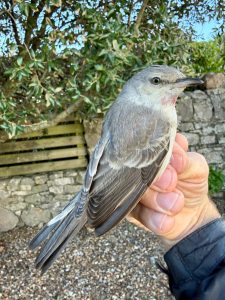
- A first winter barred warbler captured at Southgate on 18 November. The bird was caught during a short weather window in which an influx of migrant thrushes was noted. It represents only the second record of the species for the Gower Ornithological Society recording area and is the first to be ringed by the group.
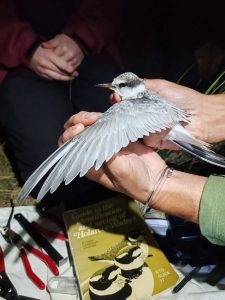
- A juvenile little tern captured on 29 August 2025 at Berges Island, Whiteford. The species is a scarce but regular passage migrant in Gower. This was also the first of the species to be captured by the group.
- A Dartford warbler ringed at Southgate on 10 December 2025. The species breeds in suitable habitat on the coastal slopes and inland commons in Gower, but is not one the group typically captures. The bird was a 1st winter, and showed considerable wear to its flight feathers.
- A male cuckoo ringed at Southgate on 1 May 2025. Another species the group captures very rarely. At least one bird had been around the adjacent coastal slope in the previous days.
- A second calendar year female kestrel, captured near Ystradfellte in the Neath Valley on 19 June 2025. The bird showed a brood patch, indicating it had bred. Our previous kestrels have typically been pulli ringed in the nest or rehabilitated birds ringed on release by Gower Bird Hospital.
- A first winter little stint captured at Weobley on 30 August 2025 during the Welsh Ringing Course. The second consecutive year in which we have captured the species.
- A total of four Siberian (tristis) chiffchaffs all trapped at Southgate. Birds were ringed on 7 November, 18 November and 4 December (2).
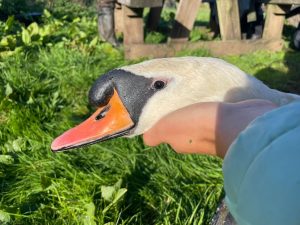
- Mute swan (6) ringed at Oxwich and Fendrod Lake, and black-headed gull caught with hand nets at Fendrod Lake, mostly during the Welsh Ringing Course. Neither species is regularly captured by the group.
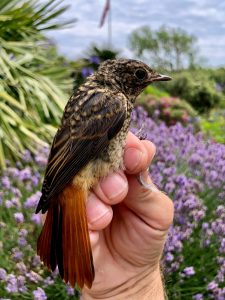
- A redstart ringed at Southgate on 1 July 2025. While not a remarkable species for the group, redstart is a very scarce breeder on Gower. The bird was in entirely juvenile plumage, indicating it had bred locally. Our typical ringing records come from outside the peninsula.
- A number of species rehabilitated, ringed and released by Gower Bird Hospital, which included buzzard, peregrine falcon and grey heron.
Notable year totals were for the following:
- Reed warbler. The 475 unique birds processed far exceeds the previous highest number of 321 in 2024. It was clear that there was good productivity in the Oxwich reed bed, and sustained ringing effort during July and August helped swell the total.
- Willow warbler. It was a record year for the species (205 individuals captured) for the ringing group, which is very welcome given its red-listed status in Wales and the wider UK. Hopefully this will be reflected in productivity studies and wider UK ringing totals.
- Jackdaw. The numbers continue to rise. The 260 individuals processed exceeded the previous best year total of 249 in 2024, which in turn far exceeded the previous best total of 110 birds in 2023. Almost all were captured at Southgate, with the new birds recruited into the colour-ringing RAS project.
- Blue tit. The total of 1,207 birds captured was the highest since 2020 and represents the second highest group total. The number and proportion of young blue tits to adults in the autumn and winter indicated high local productivity. It should also be noted that in 2020 the Covid pandemic resulted in a lot more garden ringing / ringing associated with feeding as group members were less able to be mobile. The group did far less of this in 2025.
- Coal tit. The total of 217 birds was also the highest since 2020. A late autumn influx occurred, with many of the birds captured in a single net in a Langland garden (with no feeders) (47 ringed) and in coastal scrub at Southgate (51 ringed) between late October and the end of November 2025.
It was also the best year on record for chiffchaff, whitethroat and grasshopper warbler, likely reflecting a mixture of good productivity, ringing effort and good catching weather during peak passage / dispersal periods.
Controls
Controls are birds ringed elsewhere and recovered by the Group (or refer to birds we have ringed that are subsequently caught elsewhere). In 2025 the more notable were:
- A recently fledged reed warbler ringed on 2 July 2025 at Oxwich and controlled during its southerly migration at Navarra, Spain, some 1,018 km to the south, on 10 August 2025.
- A sedge warbler ringed in the nest / with actively growing flight feathers at Claggarnagh, County Mayo on 23 July 2020 and recaptured at Oxwich (approximately 430 km to the south-east) on both 6 and 23 August 2025. The bird was a female with a brood patch and its extended stay on the marsh suggests it bred.
- A young Cetti’s warbler ringed as a male (on biometrics) at Titchfield Haven, Hampshire in early September 2025 that had moved to Oxwich by early November. A typical example of post fledging dispersal that shows how the species has been able to expand its range.
- A first winter female blackbird ringed at Kilnsea in the East Riding of Yorkshire on 28 October that had made its way to Southgate, some 363 km to the south west, by late December 2025. The record is very likely to refer to an incoming northern European bird.
- A first winter female blackcap ringed in Southgate in early September 2024 and recaptured in May 2025 by friend of the group Martin Hughes at Wydon Dene near Hexham (approximately 400 km to the north north-east).
- A unsexed starling ringed as a recent fledgling in Stockton-on-Tees in early May 2023 and recaptured at Southgate in mid-May 2025, some 374 km to the south west, by which time it was confirmed as an adult female.
Other movements included chiffchaffs controlled at Southgate that had been ringed at Tregaron, Ceredigion and in Gwynedd, and Southgate-ringed chiffchaffs that were subsequently controlled in the Nanjizal Valley, Cornwall and at Grouville Marsh, Jersey. Reed and sedge warblers moved between Oxwich and Seaton (Devon), the Carey Floodplain (Dorset) and Kenfig (Bridgend), and one of our Oxwich goldfinches was caught by Gower / Teifi group member Jane Beck at her site in Ceredigion.
In addition there were numerous colour-ringed jackdaws, and the odd dipper and rock pipit reported via the online app, and we had late news (from 2024) of Oxwich ringed blackcap and sedge warbler controlled in France.
As always, however, while these movements are of interest, much of the data the Group records and submits to the BTO is less ‘sexy’ but more valuable and concerns timing of breeding, extent of moult, stage of growth of young and various biometric information.
Aged Birds
Some of our more notable older birds recaptured during the year were:
- A blackbird ringed at WWT Llanelli in September 2015 and still going strong when recaptured at the same site in November 2025, some 9 years 38 weeks and 6 days later.
- A young greenfinch ringed at Oxwich in November 2016 and recaptured at nearby Southgate in August 2025, 8 years and 17 weeks later.
- A reed warbler ringed at Oxwich as a recently fledged youngster in August 2018 and recaptured in August 2025, 6 years, 51 weeks and 3 days later.
- A dunnock ringed as a second calendar year bird in Crynant, Dulais Valley, in January 2019 and recaptured at the same site in December 2025, 6 years, 48 weeks and 2 days later.
- A snipe ringed at Oxwich in December 2018 and recaptured at the same site in November 2025, 6 years 47 weeks and 4 days later.
Group News
Colin Baker earned his Training Endorsement, Jasmine Davies achieved an A Permit and Megan Nicklin and Kayleigh Bargus their C Permits over the year. Well done to all for their effort and commitment.
New ringing sites were started by Alice Connell, Jasmine Davies, Alex McCubbin and Megan Nicklin during the year, while Colin continued to lead the reinvigoration of the Kenfig Ringing Group.
We welcomed North Cornwall Ringing Group, led by Pete Roseveare, for a very enjoyable weekend at Oxwich in late August. It was great to establish links to the Group, all seemed to enjoy the experience, and it was nice to share ideas.
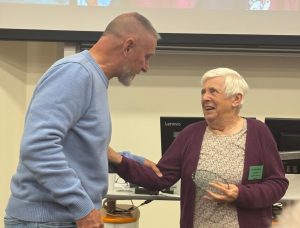
Group leader Heather Coats was awarded both the BTO’s Jubilee Medal and the Welsh Ornithological Society’s Lifetime Achievement Award, reflecting her long term commitment to bird recording, ringing and training, with the WOS award also earning her a cuddle from Iolo Williams.
Finally, the first winter male black-faced bunting captured at Oxwich in late October 2024 was accepted by the British Birds Rarities Committee. It is therefore the first record of the species for Wales.
Acknowledgements
Funding
We are extremely grateful to the Gower Society for providing an eleventh year of grant funding for ringing at Oxwich in 2025. Without this support we would need to scale back our operations, including our training.
It was also hugely beneficial to receive a grant from the Welsh Ornithological Society (WOS) for the annual Ringing Course for the second consecutive year. The grant helped us both break even, and keep the costs of the course relatively low, ensuring it was accessible to those who wanted to attend.
Finally on the grant funding front, Richard Dann would like to thank Gower Ornithological Society for ongoing funding of colour rings for the jackdaw RAS project.
Access and Training
Thanks to Nick Edwards and Ed Tucker (of Natural Resources Wales), who manage Oxwich Marsh. NRW have been consistently supportive of our efforts since we began ringing in 2013, and we are very grateful for their continued backing. Ed’s assistance in cutting extra rides ahead of the ringing course and mowing the compound in which we have our ringing stations was a great help. In addition we are grateful to Dan Pritchard for access to the Weobley track.
Heather Coats would also like to thank Jasmine Davies and the Cwm Clydach Volunteers for helping run the Cwm Clydach pied flycatcher RAS.
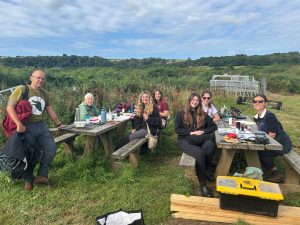
Thanks also to Martin Hughes, Chris Jones of the Teifi Ringing Group, Tony Cross (mid Wales Ringing Group), Chris Redfern (Natural History Society of Northumbria Ringing Group) and Justin Walker (BTO) for their help as independent trainers and assessors during the Ringing Course in September 2025, and to Ed O’Connor for his wader catching expertise.
Finally, thanks to Richard Dobbins, Wendy James and others from Teifi Ringing Group, as well as the Skokholm wardens (Richard Brown and Giselle Eagle) who hosted some of us on Skokholm in 2025. The experience gained ringing seabirds, using Heligoland traps and just generally ringing in a different environment was hugely helpful and very enjoyable, and everyone was very welcoming.
Group Contributions
Further thanks to members of the Gower Ringing Group who have contributed to the totals, managed data, attended sessions regularly over the course of the year or who contributed to the course we ran in the autumn, in particular: Heather Coats, Wayne Morris, Colin Baker, John Lloyd, Simon Allen (Gower Bird Hospital), Joanne Conway, Richard Dann, Alex McCubbin, Amy Schwartz, Dionne Jenkins, Miguel Lurgi, Becky Gibbs, Jasmine Davies, Alice Connell, Kayleigh Bargus, Megan Nicklin, Jane Beck, Steve Lysyj, Liane du Rouys, Ben Gamble, Jenny Taylor, Natalie Kerr, Matthew Collins and Fran King.
Due to the success of many ringing group members in achieving permits over the past couple of years, and some people relocating, we were able to advertise for new ringing trainees in the final quarter of 2025. We look forward to working with our new starters in 2026.
Photos are below (with thanks to Richard Dann and other photographers).
Owain Gabb
January 2026.



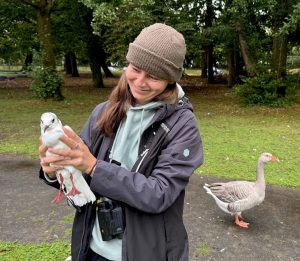
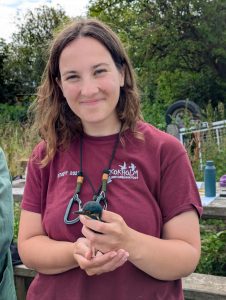
Your first kingfisher is always a special experience.
Below: Heather receiving her Welsh Ornithological Society Lifetime Achievement Award from Iolo Williams.
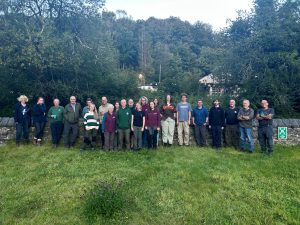
Below: the trainers, helpers and participants on the 2025 Welsh Ringing Course.
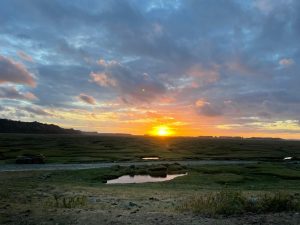
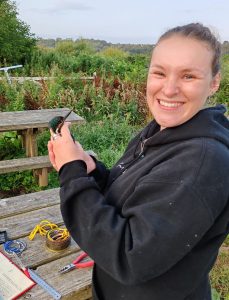
Sunset at Weobley, Burry Inlet
