The first six months of the year at Oxwich followed a familiar pattern: a weather affected first quarter; a quiet spring with recaptured birds much in evidence; and a steady increase in catches in June as juvenile birds of various species started to fledge. A lot of training, some good data collected, but no big surprises.
Until mid-June the only unexpected birds had been a spring garden warbler (normally a species that we capture in modest numbers during autumn passage) and a marsh tit, a less than annual capture at Oxwich despite good populations in the ancient semi-natural woodland that surrounds the reed bed.
On the unlikely date of 14 June the year changed in a very positive and exciting manner. Two bearded tit were captured in a line of nets running across the marsh. To say this was unexpected would be an understatement. We hadn’t heard any ‘pinging’ calls from the reedbed, and the nearest breeding population in Wales is at the Newport Wetlands, in excess of 65 miles to the east. While the species had always been on the long list of birds that might turn up, it would have been a brave ringer who would have put any money on it.
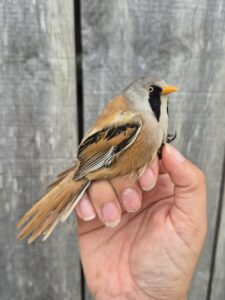
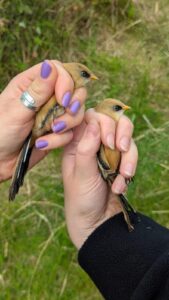
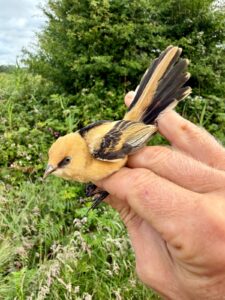
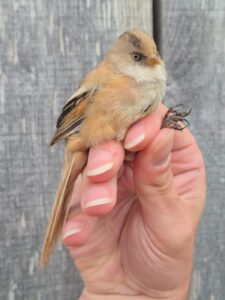
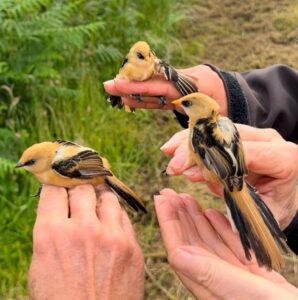
What was even more interesting was that the birds were clearly juveniles. That much was instantly apparent from their unfeathered breasts (and other bare tracts), pristine flight feathers and general appearance. And it didn’t stop there. Three more fledglings were captured on 20 June and adult male and female birds on 4 July (both of which had brood patches – indicating the male does some brooding).
The main two questions were:
- Did they breed on site? It appears almost certain that they did – it is extremely unlikely they would have been capable of significant dispersal in entirely juvenile plumage.
- If they bred, why did they go undetected? The marsh is large and if they bred away from the ringing area calls would not necessarily have been heard; there is also limited need to be territorial / vocal if there is no competition.
If we held any residual doubts about whether they had bred on site following the capture of the juveniles, these were probably put to bed with the capture of the adults in early July.
Bearded tit bred at Oxwich historically. Data collected by Dr Derek Thomas indicates they were not an uncommon capture in the 1970s and 1980s. However, by the end of the 80s their breeding status had become unclear, and the last records were in the early 1990s. It is fantastic to see them return. We hope that they will have another brood on the marsh this year, and intend to put out grit trays in an attempt to help support the population over winter. The species switches from feeding on insects in the summer to a diet of seeds in the autumn. Grit is needed to break these down.
The year to date catch at Oxwich (as of 4 July 2026) is as follows:
| Species Name | Ringed | Recaptured | Total |
| Bearded Tit | 7 | 1 | 8 |
| Blackbird | 16 | 15 | 31 |
| Blackcap | 65 | 7 | 72 |
| Blue Tit | 125 | 143 | 268 |
| Bullfinch | 3 | 1 | 4 |
| Cetti’s Warbler | 13 | 27 | 40 |
| Chaffinch | 55 | 18 | 73 |
| Chiffchaff | 55 | 5 | 60 |
| Coal Tit | 1 | 8 | 9 |
| Dunnock | 7 | 19 | 26 |
| Garden Warbler | 1 | 1 | |
| Goldfinch | 38 | 10 | 48 |
| Grasshopper Warbler | 5 | 4 | 9 |
| Great Spotted Woodpecker | 6 | 16 | 22 |
| Great Tit | 38 | 43 | 81 |
| Greenfinch | 8 | 4 | 12 |
| Jack Snipe | 1 | 1 | |
| Jay | 1 | 1 | |
| Long-tailed Tit | 11 | 5 | 16 |
| Marsh Tit | 1 | 1 | |
| Reed Bunting | 10 | 4 | 14 |
| Reed Warbler | 124 | 60 | 184 |
| Robin | 23 | 24 | 47 |
| Sedge Warbler | 31 | 28 | 59 |
| Siskin | 54 | 50 | 104 |
| Snipe | 15 | 3 | 18 |
| Song Thrush | 3 | 2 | 5 |
| Sparrowhawk | 1 | 1 | |
| Stonechat | 5 | 5 | |
| Swallow | 1 | 1 | |
| Treecreeper | 4 | 4 | |
| Whitethroat | 14 | 7 | 21 |
| Willow Warbler | 6 | 1 | 7 |
| Wren | 6 | 7 | 13 |
| Grand Total | 753 | 513 | 1266 |
The Group would like to extend our thanks to the Gower Society, who have provided us with sponsorship for the twelfth consecutive year. This supports our running costs for Oxwich where we do the large majority of our training. Without this help we would have to scale down what we do. Over the past 12 years we have trained multiple ringers, many of whom are making a substantial contribution to studying birds in Wales and elsewhere and who will become some of the conservationists at the forefront of local and national ornithology over time. It is great that the Society has been able to provide us with this consistent funding, and we are hugely grateful to them for doing so.
We are also very grateful to Natural Resources Wales for ongoing access to the marsh, and for the management works they do. Particular thanks for Ed Tucker for his assistance providing boarding to go in some of the muddier rides recently.
Thanks as always to everyone who has been out this year, particularly to the permitted ringers who contribute so much to training at Oxwich.
Some photos of the bearded tits are below.
Owain Gabb
08/07/2026
Photos (below)
- Adult male bearded tit
- Juvenile males showing black patches on lores and bright yellow / orange bills
- Juvenile female with dark bill
- Adult female. The tail and primaries were very worn and the bird showed a well defined brood patch complete with stretched skin indicating that it had formerly been engorged.
- Juveniles (female on the left with two males)