Gower Ringing Group currently has some capacity to take on new ringing trainees. If you are based in Swansea, Gower, Neath Port Talbot or the eastern part of Carmarthenshire, and would like to train as a ringer, we would be interested in hearing from you.
What does Ringing Involve?
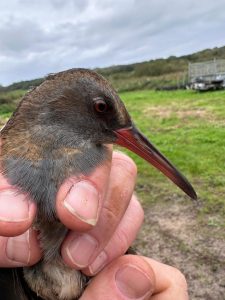
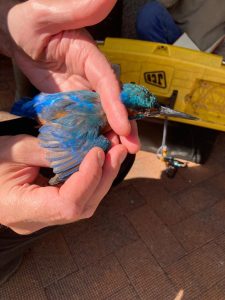
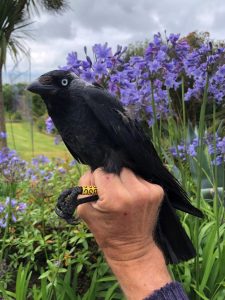
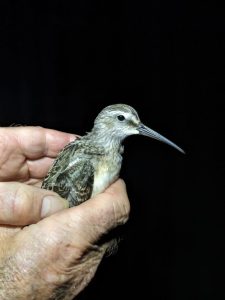
Bird ringing typically involves the capture and fitting of rings to birds. All ringing is done under the supervision of a Trainer (S Permit holder). Metal, and sometimes also colour rings are fitted. Alongside this, captured birds are aged, their condition visually assessed, and various measurements taken. The data generated helps us understand timing of breeding and of moult, how populations are doing at the national, regional and local levels, and the range of sites they use when breeding, wintering and on passage. It is input to an online database, Demon (Demography Online), making it available to the British Trust for Ornithology (BTO) for analysis, informing research and conservation efforts. Approximately 1 million birds are ringed each year in the UK.
What does Gower Ringing Group do?
Gower RG regularly capture birds at Oxwich Marsh, Gower, where much of our training is done, at Constant Effort Sites in the Dulais Valley and the Wildfowl and Wetlands Trust Reserve at Llanelli, in the Swansea Valley and on Pennard Cliffs, where we run Recapture of Adults for Survival projects on pied flycatcher and jackdaw respectively. We also capture waders at sites on the Burry Inlet and run the Welsh Ringing Course (one of very few courses run UK-wide) in the autumn of each year. A summary of our activity in 2024 is here: https://www.gowerbirds.org.uk/the-ringing-year-2024-gower-ringing-group/
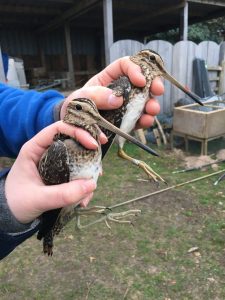
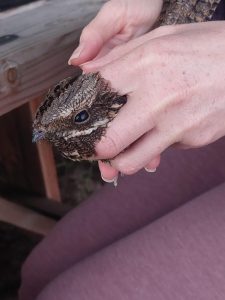
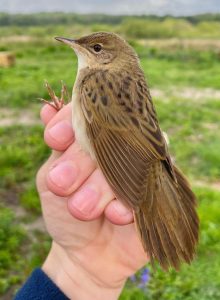
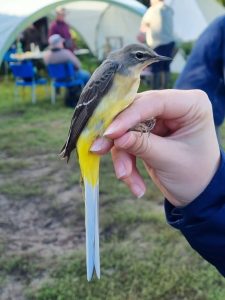
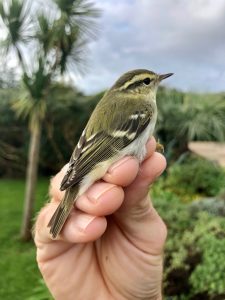
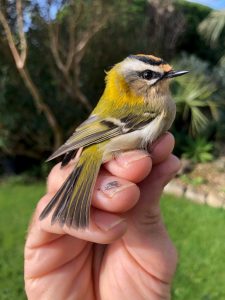
Oxwich is a particularly good training site as we are able to operate at scale and there are opportunities to catch a wide range of species over the year. These include reed bed warblers, finches, snipe species, and a wide range of passage migrants that include occasional scarce and rare species. Since 2013 well over 50,000 birds of 71 species have been captured at the site, including over 6000 swallows, 3500 goldfinches, 2500 reed warblers, 417 common snipe, 60 jack snipe, 38 firecrests, 36 yellow-browed warblers, 9 nightjar, 2 wryneck and regional scarcities such as hawfinch, little bunting and black-faced bunting (the latter being the first of the species to be recorded in Wales). Ringing is not about rarities or ‘listing,’ it is the data on commoner species which is important, but it is always nice to come across something unexpected, particularly if this is of note in terms of the recording area.
You will get lots of opportunities to visit other Gower RG sites too, as well as to link up with other ringing groups in Wales and beyond, to ring seabirds and waders as part of long term studies / monitoring work.
What Commitment is Needed?
Typically we suggest people interested in training to become a ringer come along to a few sessions before confirming they would like to be formally trained. There is commitment needed from both you as the trainee and from your trainer, who will seek to provide you with the regular opportunities needed to gain the experience to become proficient and ultimately gain a permit. We only have capacity to take on a finite number of trainees, and it takes a lot of time to train people – time which is given on a voluntary basis. It typically takes between two and three years to achieve a mist netting endorsement, following which ringers can operate under the ‘remote supervision’ of their trainer. Another few years is often needed to become wholly independent. Given that the Group will typically provide several opportunities for you to get out each week during the summer and autumn, and at least weekly (weather permitting) opportunities at other times of year, a clear desire to get out weekly is needed from trainees; we only have limited capacity to train and often have long periods in which we are at capacity and can’t take new people on.
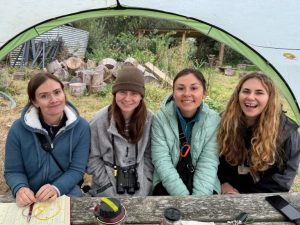
Ringing frequently involves early starts, getting cold, wet and muddy and requires a degree of physical fitness as there is a lot of walking around nets involved. Manual dexterity is needed in order to carefully extract small birds from fine mesh nets, when ringing and measuring them. The ability to work collaboratively and to listen is also required, as we operate in teams and there is a lot of information to take in if you want to progress. Everyone is welcome, and we are a very varied group (more women than men and a wide range of ages and backgrounds). We do not need you to have an academic grounding in ecology or scientific research, but a basic knowledge of and interest in birds is obviously very useful. Everything else can be taught.
Wellies, warm clothing, a love of the outdoors and an ability to drive are all needed. The sites are typically difficult to get to by public transport and lack amenities!
Why get involved?
By getting involved in ringing you will be contributing to the collection of high quality scientific data that will inform research and conservation at the local and national levels. You will also spend time outside, in beautiful places studying and improving your knowledge of wildlife. If you become permitted we encourage you to start your own studies, particularly Recapture of Adults for Survival and other projects that are of greatest value to the BTO in terms of data generated. You can also help ensure that long-running projects are sustained through your involvement, adding to their value. For those embarking on a career in ecology, whether this be conservation-led or in consultancy, it can also be very valuable in terms of your professional development and skill set.
How to get involved
If you would like to get involved, please register on the GOS website and leave a comment on this blog post. By doing so you will be providing your contact details, and we will then get in touch with you to make arrangements.
Owain Gabb
Gower Ringing Group
27/09/2025

Hello, I’m thrilled this opportunity has come up and would love to become a trainee ringer. I look forward to hearing from you.
Thanks,
Kai.
Keen to get involved, thanks
Hello, I would be very interested in this and would love to get involved in this ringing group
Hi, myself and my partner Stuart are very interested in being involved, thankyou
I am interested in doing the bird ringing training.
I’m interested in getting involved
🙂
Hello, I am interested in joining the ringing group please.
I’d like to get involved 🙂
Hello! I would like to get involved with this 🙂