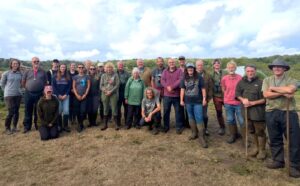
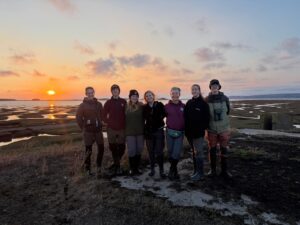
The Welsh Ringing Course was held between 27 and 31 August 2026 inclusive. The course was first hosted by Gower Ringing Group in 2015, and this was the tenth running of it.
The 2026 course enabled a number of assessments for permit upgrades as well as providing participants with a wide range of additional experience. Participants came from ringing groups that included North Solway RG, North Kent RG and Pembrokeshire RG as well as trainees from independent ringers based in Devon, Wiltshire and Bristol.
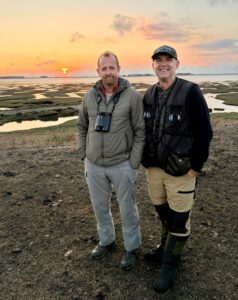
There were ten ringing trainers present for the duration of the weekend: Martin Hughes (independent / Northumberland), Heather Coats, Wayne Morris, Dionne Jenkins and Owain Gabb (Gower Ringing Group), Justin Walker (BTO), Paddy Jenks (independent Pembrokeshire based), Mark Grantham (West Cornwall Ringing Group), Chris Jones (Teifi Ringing Group), and Chris Redfern (Natural History Society of Northumbria Ringing Group). Additional support was provided Miguel Lurgi for spring trapping at Overton, and a capable team of helpers that included Jane Beck, Jasmine Davies, Megan Nicklin and Jo Conway.
The itinerary included daytime mist netting at Oxwich Marsh, spring trapping in the intertidal at Overton, dazzling of waders at Weobley on the Burry Inlet and targeting wildfowl at Fendrod Lake and nearby waterbodies in Swansea Vale.
As in 2025 and 2024 the course was hugely weather affected, with a low pressure system bringing wind and rain that impacted on all of our attempts to catch birds. Weather had led us to increase the length of the course by a day this year, and the extra day proved hugely important in giving the training team time to take a good look at participants and provide them with constructive informed feedback.
A total of 625 birds of 33 species were processed (as compared with 437 of 36 in 2025, 411 birds of 37 species in 2024 and 853 birds of 34 species in 2023). While the total compares favourably with the past two years, which were considerably weather affected, it does not approach the total in 2023, when weather was far better. The moderate 2026 total reflects the fact that we failed to get a single mist netting session completed in good ringing weather; all were short and generally unfavourable. Regular showers, some of which were thundery, and blustery winds were frustratingly persistent. In addition, the full moon, in conjunction with the time of high tide on the Burry Inlet during the weekend, significantly complicated the capture of waders.
The breakdown was as follows:
| Species Name | Ringed | Recaptured | Total |
| Blackbird | 3 | 4 | 7 |
| Blackcap | 57 | 1 | 58 |
| Blue Tit | 27 | 32 | 59 |
| Canada Goose | 2 | 2 | |
| Cetti’s Warbler | 2 | 2 | 4 |
| Chaffinch | 4 | 4 | |
| Chiffchaff | 8 | 2 | 10 |
| Dipper | 3 | 2 | 5 |
| Dunlin | 2 | 2 | |
| Dunnock | 4 | 10 | 14 |
| Garden Warbler | 1 | 1 | |
| Goldfinch | 20 | 7 | 27 |
| Grasshopper Warbler | 14 | 2 | 16 |
| Great Tit | 1 | 16 | 17 |
| Greenfinch | 14 | 2 | 16 |
| Grey Wagtail | 1 | 1 | |
| Kingfisher | 2 | 2 | 4 |
| Long-tailed Tit | 1 | 1 | |
| Mute Swan | 1 | 1 | |
| Reed Warbler | 34 | 21 | 55 |
| Ringed Plover | 1 | 1 | |
| Robin | 5 | 5 | 10 |
| Rock pipit | 10 | 10 | |
| Sand Martin | 58 | 58 | |
| Sedge Warbler | 55 | 1 | 56 |
| Siskin | 1 | 1 | |
| Stonechat | 2 | 2 | |
| Swallow | 155 | 1 | 156 |
| Tree Pipit | 4 | 4 | |
| Whinchat | 1 | 1 | |
| Whitethroat | 7 | 2 | 9 |
| Willow Warbler | 7 | 7 | |
| Wren | 3 | 3 | 6 |
| Grand Total | 510 | 115 | 625 |
Daytime Mist Netting
Mist netting sessions were held at Oxwich on the Thursday evening, Friday, Sunday and Monday mornings and on Saturday afternoon. Nets were set in habitats including reed bed, fen and damp scrub.
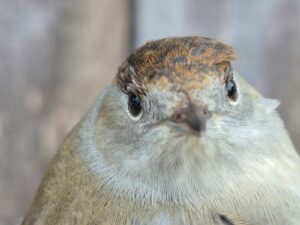
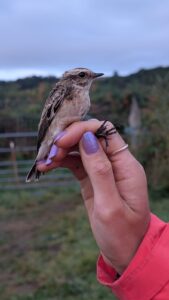
The most commonly captured species at Oxwich during diurnal sessions were blackcap (58 individuals), sedge warbler (56) and reed warbler (55 birds). Less regularly-captured species for the site were a first winter whinchat, four tree pipit and a record 16 grasshopper warblers. The swallow roost session on the Thursday evening was very successful, with 155 swallows and 57 sand martins captured (singletons of both species were caught during separate morning mist netting sessions as they emerged from their roosts). The hirundines included a significant number of adults of both species, including a sand martin in main moult (most adults only do a summer partial moult and complete their main moult in winter).
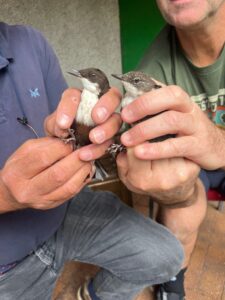
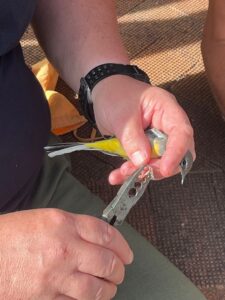
We also put out a net back at the Guides Centre in Parkmill, where we were staying, during dry periods in the afternoons. As a result we managed to catch three different kingfishers (including a bird initially ringed at Oxwich) and four dippers at the site. The dippers were interesting in that we caught juveniles likely to be from different broods fledged in 2026, as one was significantly more advanced in its moult than the second, and we also captured a bird we had initially ringed at the same site in 2025.
Spring Trapping
Spring trapping was undertaken on the storm beach at Overton between mid-morning and mid afternoon on the Sunday, with a repeat visit on the Monday morning (as the Sunday session was curtailed by weather). The sessions were led by Miguel Lurgi, who is doing a population study of rock pipits in Glamorgan. A two-shelf net complemented the spring trapping on the Sunday.
Ten rock pipits were captured and colour ringed by course participants. Two stonechats were also captured and ringed.
Wader Dazzling
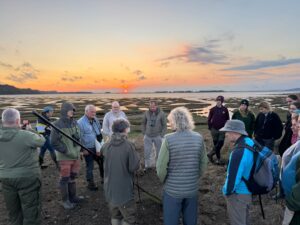
Wader dazzling took place on the Friday evening. Weather was generally unfavourable at other times. The efforts were led by Dionne Jenkins and Paddy Jenks. Torches and thermal cameras were used to locate birds.
Despite being up against it in terms of light levels and time of high tide in relation to dusk, a few waders (both dunlin and ringed plover) were captured and participants were given opportunities to try dazzling for themselves. Birds were held in pens to allow re-acclimatisation to light prior to their release.
Gull and Swan Ringing
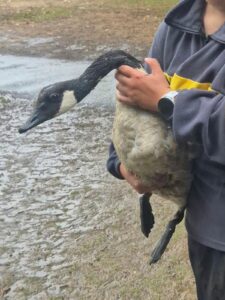
Due to the poor weather on the Saturday morning we headed to Fendrod Lake and surrounding waterbodies to target waterfowl. The mute swans were wary and we only captured one, along with two Canada geese. Controlling and putting larger rings onto these birds provided the participants with useful experience.
Other Activities
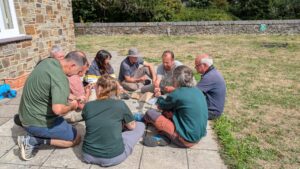
In addition to the various capture techniques, Chris Jones re-ran his under-tail coverts identification quiz, Martin Hughes challenged all-comers with an exercise in linking bird biometrics to species from a list provided, and Mark Grantham provided a talk which touched on various aspects of ringing including advice on ringing in relation to social media. Mark also led an exercise in applying large rings (blanks) to artificial bird legs that the BTO had provided us with.
Acknowledgements
Feedback on the weekend from attendees was very positive. Many people got to see new techniques, and all visited a range of sites and handled new species. The weather being so unsettled didn’t help, but everyone remained upbeat over what was a very tiring course.
Particular thanks are due to the visiting trainers, Martin, Justin, Chris Jones, Chris Redfern, Mark and Paddy for giving their time and expertise so freely, to Dionne for her additional wader-catching efforts, to Miguel for running the sessions at Overton, and to the helpers for their willingness to take on a wide variety of tasks that made running the course more straightforward. Heather was also instrumental in organising the catering and liaising with the centre over accommodation.
Thanks also to Dan Pritchard and the National Trust for access to use the Weobley Track and adjacent areas of grazing marsh respectively, to Natural Resources Wales (particularly Ed Tucker) for all the work they do at Oxwich and allowing us access, and to the Welsh Ornithological Society for grant funding towards the course. We try and keep the charge for the course as reasonable as possible (to promote inclusivity), and this funding together with a modest course fee has allowed us to largely cover our costs. We are also hugely grateful to the Gower Society for their ongoing support to our efforts at Oxwich, and the contribution this makes to allow us to continue to train many of the next generation of ornithological data gatherers and researchers in South Wales.
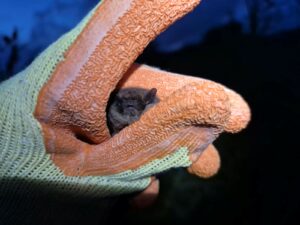
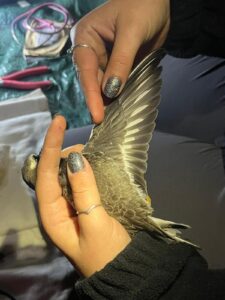
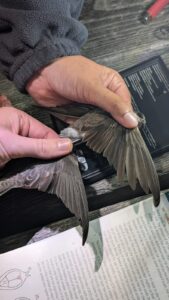
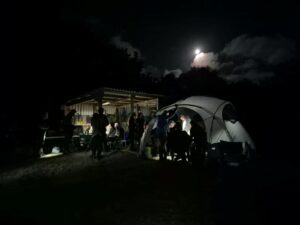
Photographs are below.
Owain Gabb
31/08/2026